Why the Errand Outfit Fails on the Fourth Stop, Not the First

Quick Answer: Outfits fail late in a multi-stop day for three cumulative reasons: swelling (feet and hands enlarge measurably over hours of standing and getting in and out of a car), friction debt (a seam that rubs imperceptibly per step becomes a hot spot after five thousand of them), and temperature whiplash (each car-to-shop transition is a full climate change, and the fourth one lands on a body that is already thermally confused). The fixes are boring and highly effective: shoes with adjustable volume, a waistband that does not depend on sitting posture, and a bag worn crossbody rather than on a shoulder.
Stop one is fine. Stop two is fine. By stop four you are aware of your left shoe, your waistband has become a topic, and you would genuinely consider going home without the last two items on the list.
Nothing changed about the outfit. What changed is that everything small has been accumulating for three hours.
The good news is that late-day failure is far more predictable than it feels, and it concentrates in exactly three places.

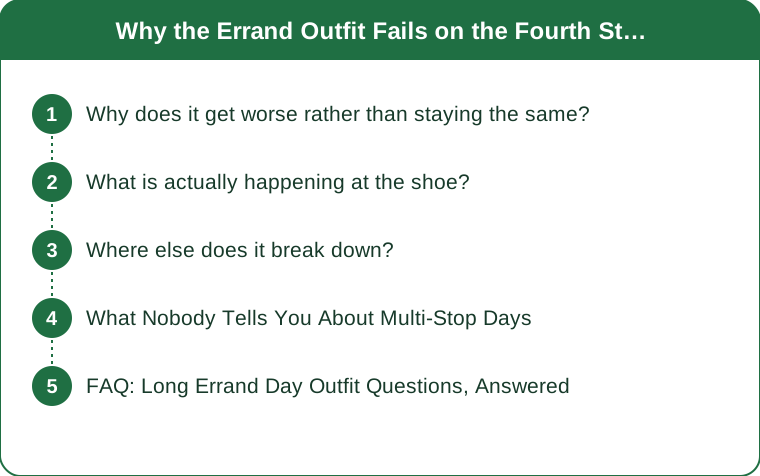
Why does it get worse rather than staying the same?
Because three things accumulate on a curve rather than staying flat, and all three peak at the same time.
Your feet get bigger. This is measurable, not a feeling. Feet swell over a day of standing and walking - the commonly cited figure is up to half a size by late afternoon, and more in warm weather or after a lot of time on hard floors. Shop floors are concrete under thin tile, which is about the least forgiving surface there is. A shoe that fits perfectly at 9am is genuinely a different fit at 2pm.
Friction accumulates. A seam that rubs 0.1mm per step is irrelevant for a hundred steps and a hot spot after five thousand. A multi-stop errand day is routinely eight to twelve thousand steps, most of them on hard surfaces with stops and starts. The rub is not worse at stop four - it has just been happening the whole time.
Thermal load accumulates. Every car-to-shop transition is a climate change: a warm car, a cold supermarket, a warm car park, an overheated pharmacy. Your body spends energy adjusting each time. By the fourth transition it stops adjusting cleanly and you end up simultaneously clammy and cold, which is the specific late-errand feeling everyone recognises.
And a fourth, quieter one: load asymmetry. Bags carried on one side, a car door pulled with one arm, a child’s hand held in the same hand each time. Three hours of asymmetric loading shows up as a shoulder and neck ache that people blame on stress.
Late August adds a specific version of this. The car is genuinely hot in the afternoon while the mornings have turned cool, so the temperature range within a single day is wider than at any other point in the year. An outfit chosen for a 7am chill is being asked to work in a 3pm car.
What is actually happening at the shoe?
The shoe is where most late-day failure lives, and volume matters more than length.
When feet swell, they mostly get wider and deeper rather than longer. So the failure is not that your toes hit the end - it is that the upper is pressing across the top of the foot, and the pressure has nowhere to go.
This is why adjustable volume beats a perfect fit. A lace-up shoe, a shoe with a strap, or one with a genuine range of adjustment lets you loosen at stop three and continue. A slip-on has one setting for the entire day, and that setting was chosen at 9am for a foot that no longer exists.
The practical version:
Choose a lace-up or adjustable shoe for a day with four or more stops. This is the single highest-value change on the list and it is almost cost-free.
Lace them slightly loose at the start. You will tighten them if you need to, which almost nobody ever does, and you will avoid the situation where there is no adjustment left in the direction you need.
Socks matter more than expected. A seamless or flat-toe-seam sock removes an entire category of hot spot. Cotton holds moisture, moisture increases friction, and increased friction on a swollen foot is exactly where blisters come from.
Do not wear brand new shoes on an errand day. Obvious, routinely ignored, and errand days are the highest-step-count days most people have that they do not think of as exercise.
And if you know one specific spot always rubs, tape it before you leave. A strip of kinesiology tape or a blister plaster applied preventatively works far better than one applied after the skin has already gone. Thirty seconds at the door.

Where else does it break down?
The waistband and the bag, in that order.
The waistband problem is a posture problem. Most trousers and leggings are fitted while standing. An errand day involves a lot of sitting - in a car, repeatedly, for short periods - and a waistband that is comfortable standing can dig noticeably when seated with a seatbelt across it.
What works: a wide waistband rather than a narrow one (pressure spread over more area), a fabric with genuine recovery so it does not stretch out and slide down across the day, and avoiding anything that relies on a fixed closure at a single point. A single button or a rigid hook concentrates all the pressure in one centimetre, which is fine for an hour and not for five.
A specific and common failure: a mid-rise that sits exactly at the crease where you fold when seated. It will roll, every time, and it will roll more each time you get out of the car. Either higher or lower is more stable than exactly at the fold.
The bag is the second one, and crossbody is the answer. A shoulder bag requires continuous low-level muscular effort to stay on, which you do not notice and which is genuinely tiring across three hours. It also slides off when you reach for something, which is how bags end up hooked over a forearm along with everything else.
Crossbody, worn on the opposite side from whatever you carry most. And if you are doing a grocery stop, the answer is a bag that lives in the car rather than a bag you carry - the best carrying solution for four bags of shopping is not carrying them.
One more: layers you can remove and actually stow. A cardigan you have to carry becomes another item in your hands, which is the resource under most pressure. A layer that packs into the crossbody bag, or that you can leave in the car between the cold stop and the warm one, does not.
What Nobody Tells You About Multi-Stop Days
The order of the stops matters more than the outfit. Cold stops - supermarket, pharmacy refrigerated section - are more comfortable early when you are still warm from home. Doing the freezer aisle at stop five, when you are already thermally depleted, feels dramatically worse. This is free to change and almost nobody does it.
Hands are the bottleneck, not endurance. Ask yourself how many things you will be holding. Keys, phone, bags, a coffee, a list, a child’s hand. Most late-day misery is about running out of hands, not about being tired. Every solution that frees a hand is worth more than any comfort upgrade to the clothes.
The car is a wardrobe and people forget this. A spare layer, a second pair of shoes, a scarf. You are returning to it between every stop. There is no reason to carry anything you can leave there, and a spare pair of shoes in the boot on a long errand day is the closest thing to a cheat code.
Public toilets end more errand days than fatigue does. Not glamorous, and true. A jumpsuit or a complicated closure system is a genuine constraint on a long day out, and it is worth factoring in honestly at 9am.
You are walking further than you think. Four stops with parking is routinely 8,000 to 12,000 steps. If you did that deliberately you would wear proper shoes and take water. It counts as the same physical event whether or not you called it exercise.
And the last one: you will be photographed at stop three. Someone runs into you, a school gate happens, a video call comes through. This is not a reason to dress uncomfortably - it is a reason to make the comfortable version look deliberate, which mostly comes down to matte fabrics, a structured outer layer, and shoes that are supportive without being obviously athletic.
FAQ: Long Errand Day Outfit Questions, Answered
What is the single best change I can make?
Adjustable shoes. A lace-up or strapped shoe that you can loosen at stop three handles the biggest cumulative variable - foot swelling - which is the thing most likely to end the day early. Nothing else on the list comes close in effect size.
How do I dress for a car that is hot and shops that are freezing?
Treat the car as the outlier rather than the baseline. Dress for the shops, which are consistently over-air-conditioned, and remove your layer in the car rather than trying to be comfortable in both. A layer that comes off in ten seconds and lives on the passenger seat solves this better than any single garment can.
Should I change outfits partway through a long day?
Usually not worth it - the exception is shoes. A second pair in the car takes no effort to use, addresses swelling directly, and gives your feet different pressure points for the second half of the day. Changing clothes mid-day generally costs more time and hassle than it returns.
TL;DR:
- Late-day failure is cumulative, not sudden: swelling, friction debt and thermal whiplash all peak at once.
- Feet swell up to half a size by afternoon - adjustable shoes beat perfectly fitting ones.
- Waistbands fail because of repeated sitting, so choose wide, high-recovery, and not exactly at the fold.
- Crossbody, not shoulder. Hands are the real bottleneck on a multi-stop day.
- Reorder the stops: cold ones early, when you are still warm from home.
The outfit was never wrong for the day. It was wrong for the fourth hour of it, and the fourth hour is entirely predictable.
Keep Reading
This article is for general informational and styling purposes only. Fit, sizing, and product availability may vary.