Errand Outfit Shoes That Survive a Six-Stop Morning

Quick Answer: A multi-stop errand morning is a walking-and-standing task with repeated in-and-out of a car, on hard surfaces, carrying uneven weight. That is a different demand from either a workout or a day at a desk. The shoe that works has a slightly wider forefoot than your gym pair, enough cushioning for concrete rather than for running, and a heel you can get in and out of without sitting down. Running shoes are usually not the right answer.
By stop four you are not thinking about your top or your leggings.
You are thinking about your feet.
Nobody plans an errand outfit around footwear, which is why the footwear is what fails.

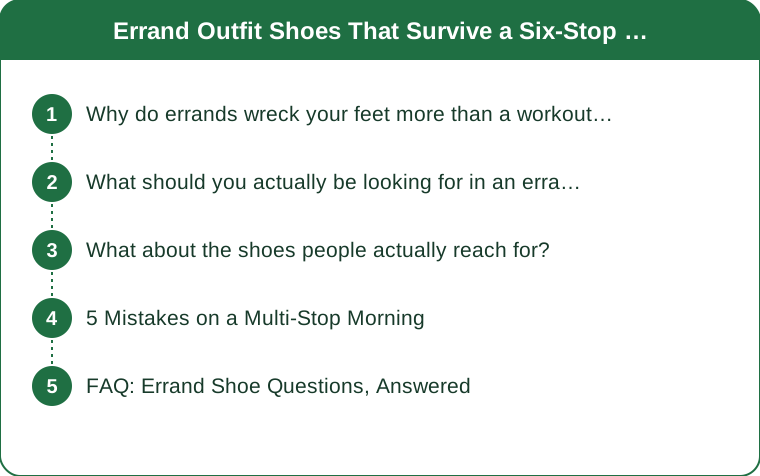
Why do errands wreck your feet more than a workout does?
Because it is a stop-start standing task on hard surfaces, and that is harder on feet than continuous movement.
A workout has a warm-up, a steady demand and an end. An errand morning is short walks separated by standing still, repeated across two or three hours, almost entirely on concrete and tile.
Standing still is the underrated part. Static standing loads the same tissues continuously without the pumping action that walking provides, which is why twenty minutes in a queue can feel worse than the walk to get there. Retail flooring is typically concrete under a thin covering with essentially no give.
Then there is the carrying. Errands involve asymmetric load - a bag on one shoulder, a child on one hip, a box under one arm. Uneven load changes gait subtly and loads one side more, which builds up over a couple of hours.
And the in-and-out of the car matters more than it seems. Each transition involves a step down, a twist, and often a rush. Six stops is twelve of those, and it favours a shoe that is stable at the heel.
Total duration is the thing people underestimate. A six-stop morning routinely runs 4,000 to 7,000 steps across two to three hours with a lot of standing in between. That is a real physical demand that nobody has planned footwear for.
What should you actually be looking for in an errand shoe?
Four specifics, and only one of them is cushioning.
Enough forefoot width, because feet spread when standing. Feet swell measurably across a day and spread under static standing load. A shoe that fits perfectly at 9am can be tight by 11am, which is why a slightly roomier forefoot than your gym pair is the right call rather than the same fit.
Cushioning tuned for concrete, not for running. This means moderate and firm rather than maximal and soft. Very soft midsoles feel excellent for the first twenty minutes and produce more fatigue over hours of standing, because the foot is working continuously to stabilise on a surface that keeps giving way.
A secure heel you can still get in and out of. This is the actual trade-off in errand footwear. A backless shoe means your toes grip to keep it on, which is a low-grade effort sustained across the whole morning. A firm heel counter with a wide opening, or a slip-on with a proper structured back, gets both.
Outsole grip that works on wet tile. Supermarket entrances, car park ramps and tiled floors in wet weather are the realistic hazard. Look for a rubber outsole with actual pattern, not a flat gum sole that looks nice and slides.
What does not matter as much as people think: weight. A few extra grams is irrelevant over 5,000 steps. Support structure and fit matter far more, and lightweight is often achieved by removing exactly those things.
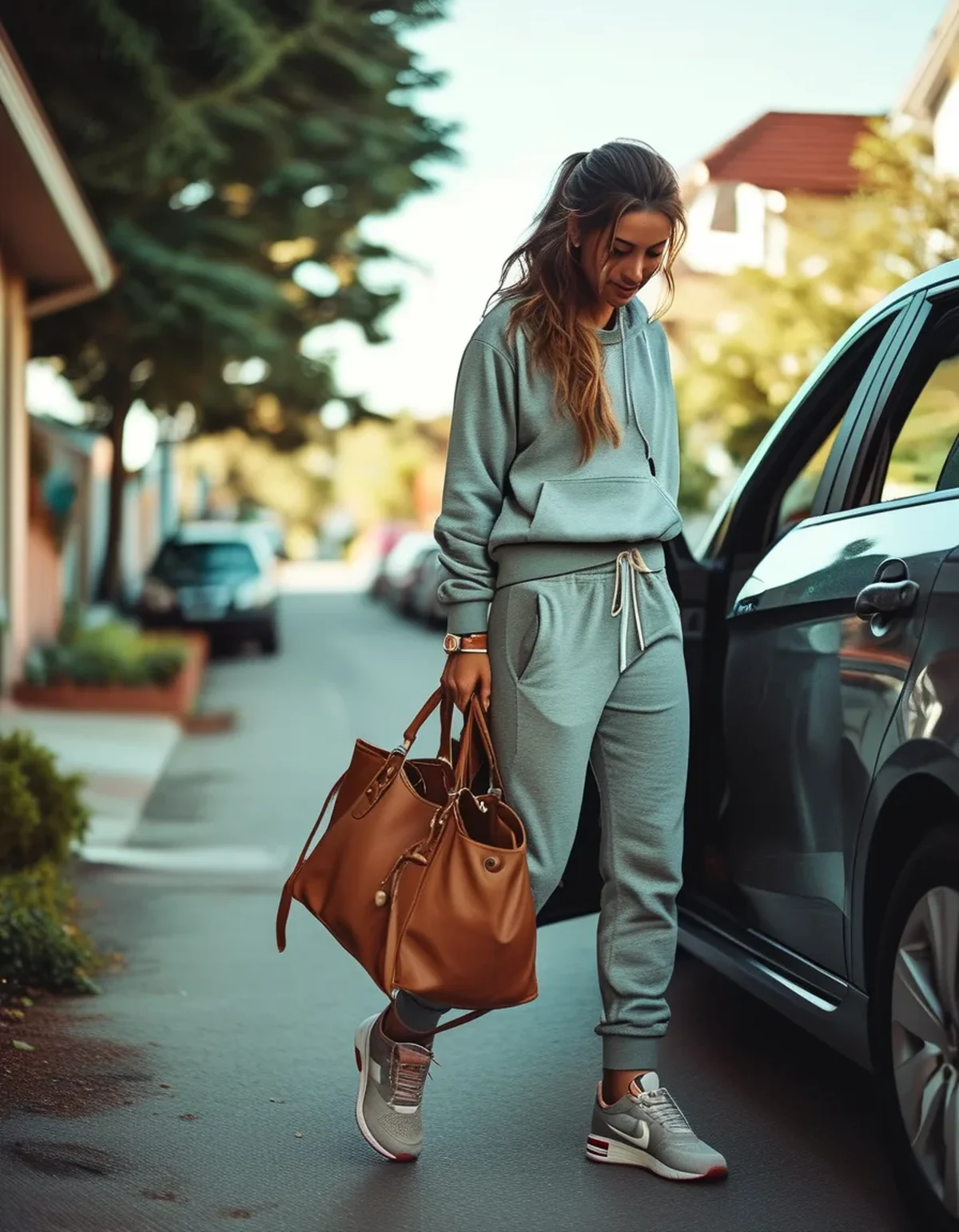
What about the shoes people actually reach for?
A quick honest run through the usual suspects.
Running shoes. Better than most alternatives and not optimal. They are built for repeated forward loading, often with a soft midsole tuned for impact absorption rather than static standing. They work, and a dedicated walking or lifestyle shoe generally works better for this specific use.
Slides and pool sandals. The worst realistic option for a long errand morning. No heel retention means constant toe gripping, and the flat footbed offers essentially nothing over hours. Fine for two stops, punishing at six.
Ballet flats. Thin sole, no arch structure, and usually a shallow heel cup. On concrete for three hours this is genuinely uncomfortable for most people, however good it looks.
Chunky lifestyle sneakers. Often the best of the common options. Wide platform, firm midsole, structured heel, decent outsole. The main risk is a stiff sole unit that does not flex at the ball of the foot, which is worth checking by bending it in your hands before buying.
Supportive sandals with a proper footbed. Genuinely good in warm weather if they have a back strap. Without a back strap you are back to the toe-gripping problem.
Boots in autumn. Fine if broken in, and worth a specific check: boots are usually a size less forgiving to foot swelling, so the ones that feel perfect first thing can be uncomfortable by stop five.
The recurring theme: heel retention and a firm-ish sole beat everything else. Those two account for most of the difference between a comfortable morning and a bad one.
5 Mistakes on a Multi-Stop Morning
1. Choosing shoes last. The shoes decide whether the morning is comfortable, and they get picked after the outfit is already set. Pick the shoes first and build around them - the outfit is far more flexible than your feet.
2. Wearing brand new shoes on an errand day. A six-stop morning is a poor place to discover a rub point. Anything new gets a short trial first, because unlike a workout you cannot stop early.
3. Ignoring socks. Socks are a bigger comfort variable than most people credit on a long standing day. Cotton holds moisture and creates friction once damp, and a thin dress sock in a sneaker is a blister waiting to happen. A cushioned synthetic or wool blend is a genuinely noticeable upgrade.
4. Assuming morning fit equals afternoon fit. Feet swell across a day and under standing load. A shoe with no room at 9am is tight at noon. Try shoes on later in the day when buying, and leave a bit of room for the errand pair specifically.
5. Backless anything for a long morning. Mules, slides, and backless sneakers all require your toes to work continuously to hold the shoe on. It is a small effort that becomes a real one over three hours, and it is the most common source of unexplained foot fatigue after an errand day.
A sixth for the car-heavy version: a shoe that is a nuisance to get on and off costs you something twelve times across a six-stop morning. Laces you have to retie are worse than they sound.
FAQ: Errand Shoe Questions, Answered
Are running shoes fine for errands?
They work and they are not optimal. Running midsoles are tuned for repeated impact rather than for hours of standing, and very soft ones produce more fatigue over a long standing morning. A firmer walking or lifestyle shoe generally does the job better.
Why do my feet hurt more after shopping than after a run?
Static standing on hard flooring loads tissues continuously without the circulatory pumping that walking provides, and retail floors are concrete with almost no give. Duration plus hardness plus standing is a harder combination than most people expect.
Should errand shoes be a half size bigger?
A little extra room in the forefoot is worth having, since feet swell and spread over a standing morning. Rather than going up a full size, look for a wider forefoot in your normal size - length that is too long creates its own problems.
Are supportive sandals okay for errands in warm weather?
Yes, if they have a back strap and a structured footbed. Without a back strap your toes grip to hold them on for the whole morning, which is the same problem as slides.
What is the single best upgrade if I only change one thing?
Socks, surprisingly often. A cushioned synthetic or wool-blend sock instead of a thin cotton one costs very little and changes how a three-hour standing morning feels.
TL;DR:
- Errands are a standing-and-walking task on concrete with asymmetric carrying - a different demand from a workout
- Prioritise heel retention and a moderately firm sole; those two decide most of the comfort
- Allow forefoot room, because feet swell and spread across a standing morning
- Backless shoes make your toes work continuously for hours, which is the most common hidden cause of foot fatigue
- Very soft cushioning feels great early and produces more fatigue over a long standing day
- Socks are a bigger variable than people expect - synthetic or wool blend, not thin cotton
Pick the shoes first and let the outfit follow. Your feet are the part that cannot be adjusted at stop five.
Keep Reading
This article is for general informational and styling purposes only. Fit, sizing, and product availability may vary.