What to Wear When a Quick Errand Turns Into Three Hours

Quick Answer: The failure point in errand outfits is almost never the top - it is footwear chosen for a five-minute walk and a waistband chosen for sitting. Build around shoes you could genuinely walk two miles in, a waistband that works both seated in a car and standing in a queue, and one layer you can remove and carry without hands. Everything else is negotiable.
A quick errand becoming a long one is not the exception. It is the normal outcome, and it is worth dressing for.

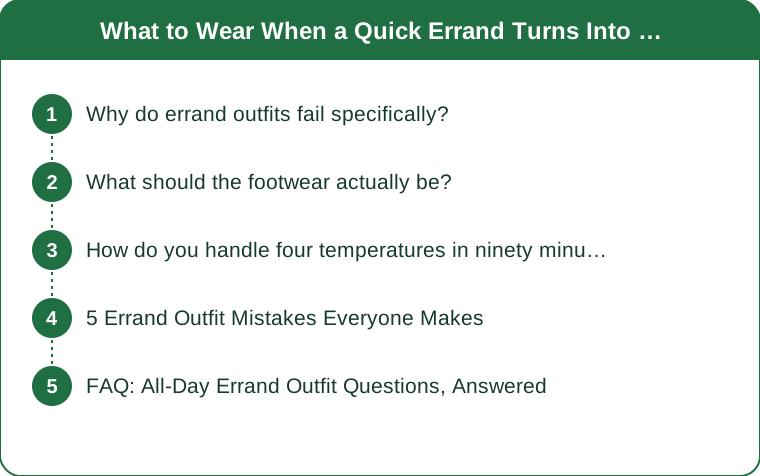
Why do errand outfits fail specifically?
Because you dress for the version of the trip you planned, and errands are the category of activity most likely to expand.
A workout has a known duration. A dinner has a known duration. An errand has a stated duration of twenty minutes and an actual duration determined by a queue, a wrong item, a second stop that occurred to you in the car park, and a phone call.
That mismatch shows up in three specific places:
Shoes. You choose based on the walk from the car to the door. The actual day involves standing on hard floors, a car park that was full, and stairs. Hard retail flooring is genuinely punishing - concrete under vinyl has almost no give, and 90 minutes on it in unsupportive shoes is more fatiguing than a walk of the same length on a path.
Waistband. You dress standing up. Then you spend a meaningful fraction of the trip seated in a car with a seatbelt across your lap. A waistband that is fine standing can dig noticeably when seated, and by the third stop it is the thing you are thinking about.
Temperature. Errands cross more environments than almost any other activity - a hot car park, an aggressively air-conditioned supermarket, an overheated pharmacy, the car again. That is four distinct temperatures in ninety minutes, and no single garment is right for all of them.
Once you see the pattern, the fix is not a better outfit. It is choosing for the long version by default, because the long version costs you nothing on the short days.
What should the footwear actually be?
This is where the largest single improvement lives, and most people underinvest here.
The standard is straightforward: shoes you would be willing to walk two miles in. Not shoes you could survive two miles in. Shoes you would choose.
That rules out more than it sounds like:
- Flat, unsupported slides and thin ballet flats. Fine for the car-to-door version. Genuinely painful after 90 minutes on retail flooring, because there is no arch support and no cushioning between you and concrete.
- Anything being broken in. An errand run is exactly the wrong place to test new shoes, because you cannot leave.
- Backless anything, if there are stairs or a car park involved. The gripping motion your toes make to keep a backless shoe on is a real, cumulative source of foot fatigue.
What works: a cushioned trainer, a supportive sandal with a proper footbed, or a low sneaker with real midsole. In mid-August, breathability matters as much as support - a closed shoe in a hot car park is its own problem, and damp feet in an unsupportive shoe is the fastest route to a blister.
Socks are not a detail. If the shoe takes socks, wear ones that actually manage moisture. A cotton sock in a warm closed shoe over three hours is the standard blister recipe.
One useful heuristic: the shoes should be boring. Errand-day footwear is the one category where the correct answer is almost always the pair you stop noticing.

How do you handle four temperatures in ninety minutes?
By choosing a layer you can carry rather than one you have to wear.
The temperature swing on a late-summer errand run is genuinely large. A car that has been in the sun can be 20 to 30 degrees Fahrenheit hotter than the supermarket you are walking into, and supermarket refrigeration aisles are colder still. You will be too hot and too cold within the same half hour, guaranteed.
The solution is not a compromise garment. Compromise garments are wrong in both directions. It is a base you are comfortable in at the hot end plus one removable layer sized for the cold end.
What makes a layer carryable:
- It packs into itself or folds flat into a tote you are carrying anyway.
- It ties at the waist without bulk - a light overshirt or thin cardigan works, a structured jacket does not.
- It weighs almost nothing, because you will be carrying it alongside bags.
The tote is doing real work here and deserves a moment of thought. A tote you are already carrying converts your removed layer from a burden into a non-issue. A cross-body bag plus a tote is the highest-functioning combination for this specific day, because it keeps your phone and keys accessible while the tote absorbs everything else.
One small thing that pays off disproportionately in August: something for the back of the neck in over-air-conditioned spaces. A light scarf in the tote weighs nothing and solves the specific chill that comes from walking sweaty into refrigerated air.
5 Errand Outfit Mistakes Everyone Makes
-
Dressing for the car, not the walk. The car is the shortest part of the trip and the only part where the outfit does not matter. Dress for the standing.
-
A waistband that only works standing. Sit down fully before you leave. If the waistband digs when seated with a seatbelt across it, it will be the dominant sensation by stop three. A soft or slightly higher waistband solves this without looking like activewear.
-
Choosing a bag with no free hands. Two shopping bags plus a shoulder bag that slides off means you cannot get your phone out at the till. A cross-body worn to the back is the single highest-value swap.
-
White or very light bottoms on a car-heavy day. Car seats, petrol pumps, kerbs, and a coffee lid at a red light. This is not fussiness - it is a genuinely higher-risk day for clothing than a normal one.
-
No pockets at all. Parking tickets, receipts, a phone you need in a queue, keys you need in a car park. A day of small in-and-out transactions is the day pockets matter most, and it is exactly the day people wear something without any.
The fourth one is the one people dismiss and then remember for the rest of the day.
FAQ: All-Day Errand Outfit Questions, Answered
Can I just wear activewear?
Yes, and plenty of people do. The only caveat is the temperature swing - a lot of performance fabric is designed for movement-generated heat, so it can feel cold in a heavily air-conditioned shop when you are walking slowly. A cotton-blend or modal top over leggings handles the standing-around parts better than a full technical kit.
What about a dress for errands?
A good option in August heat, with one condition: pockets or a cross-body, and shorts underneath if you will be getting in and out of a car repeatedly. A midi in a fabric that does not cling handles the car-to-air-conditioning swing well.
How do I stop feeling underdressed if I end up somewhere unexpected?
One structured element does most of the work. A collared overshirt, a real belt, or a clean pair of trainers rather than worn ones will carry an otherwise casual outfit into a café or a school office without any change. Structure reads as intentional in a way that fabric does not.
TL;DR:
- Errands expand, so dress for the three-hour version by default - it costs nothing on the short days.
- Footwear is the biggest lever: shoes you would choose for a two-mile walk, never shoes being broken in.
- Expect four temperatures in ninety minutes; solve it with a carryable layer, not a compromise garment.
- Check the waistband seated with a seatbelt on, before you leave.
- A cross-body plus a tote keeps both hands free, which is what actually determines whether the day feels easy.
The reliable test: sit down, stand up, walk a lap of the house. Anything you notice in those three moves you will notice fifty more times before you get home.
Keep Reading
This article is for general informational and styling purposes only. Fit, sizing, and product availability may vary.